Radio channel coordination using UKE data
Radio channel coordination in seconds rather than hours, using a tool I built around UKE data and its reconstructed calculation process.
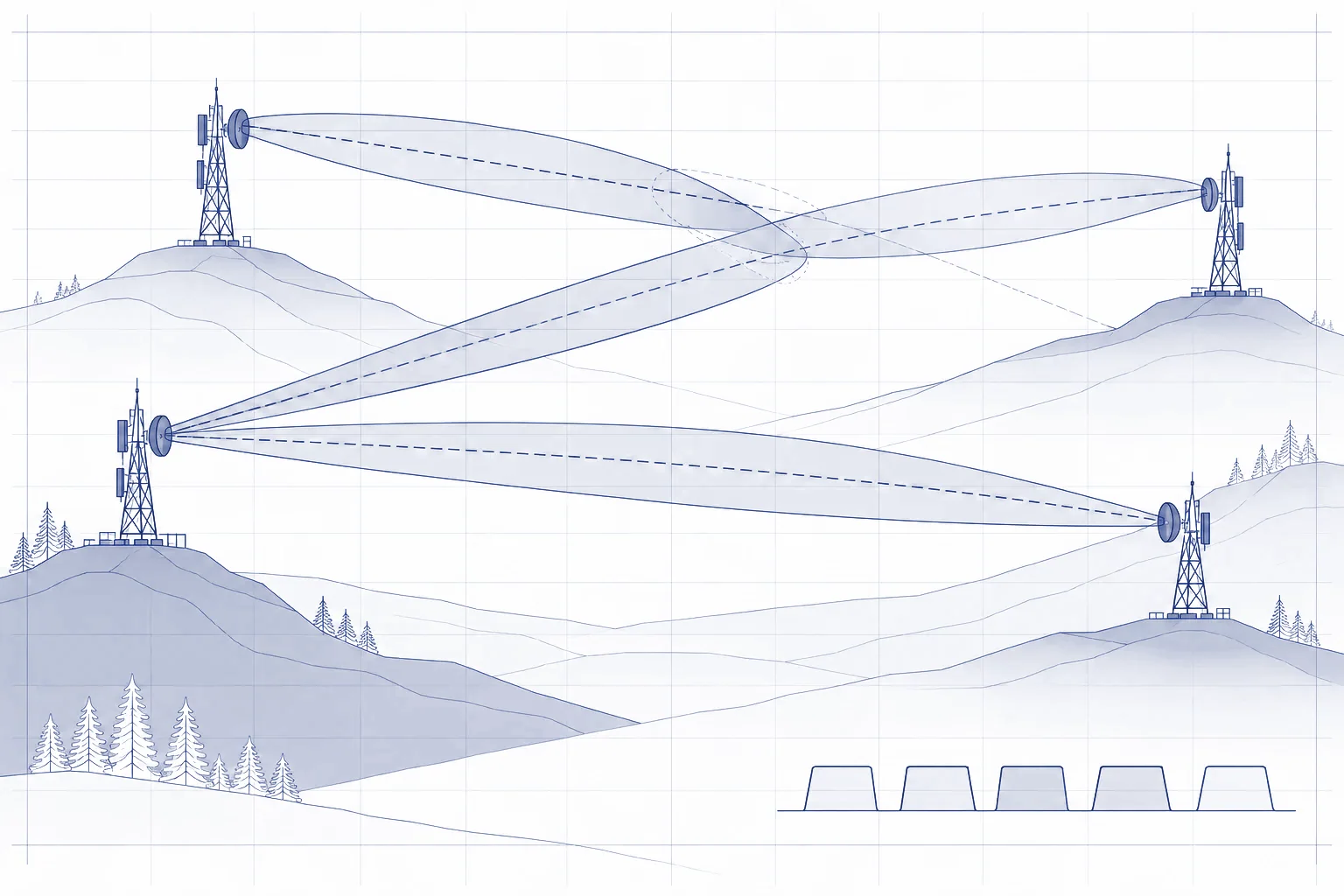
Problem
Official UKE consultations use an older Access application. Channel coordination could take hours, making it difficult to compare options for a planned link efficiently.
Solution
The application reads link parameters from a WLR file, uses a local database built from UKE publications and compares candidate channels. It presents results on a map, in a channel summary and in a PDF report.
My contribution
Taking the project from idea to working application: reconstructing UKE’s calculation process, building the tool and validating the results.
Result
Channel coordination reduced from hours to seconds, with results closely matching the original tool.
From hours to seconds
I built this project from the ground up. Channel coordination in the older Access tool used in UKE consultations could take hours. I wanted to make it faster while keeping the results consistent with the original.
The new tool performs this work in seconds, with a high level of agreement. The main challenge was understanding and reproducing how the original tool calculates interference and determines which channels are suitable.
From link parameters to channel selection
A WLR file supplies the geometry and parameters of the planned radio link. Reference data comes from the MDB database published by UKE, converted to SQLite along with an antenna catalogue. The tool combines data preparation, analysis and presentation in one process.
The map shows the link under analysis and potential conflicts. The summary lets users compare channels, and the PDF report preserves the result for further work. The scope is described in the project repository.
Assessing mutual interference
The analysis checks interference in both directions, treating each link as a potential source of interference and as an affected receiver. It uses antenna patterns and radio masks. Candidates are classified as accepted, conditional or rejected.
A clear line of sight does not guarantee a suitable radio channel. Interference from other links must be assessed separately. The architecture documentation describes the calculations and application layers.
Reconstructing the process and its limits
Part of the project involves reconstructing the process stored in the Access database: queries, macros and successive classification stages. The documentation separates link-pair calculations from result aggregation and final channel status assignment.
The model is still being developed. The reconstructed logic is not an official UKE specification; terrain topography and morphology are not yet fully incorporated. The result supports the engineer’s assessment. The reconstruction status is described in the process documentation.
Technologies
Python, FastAPI, Pydantic, SQLite, Leaflet, JavaScript, MDB → SQLite
Links and resources
Last updated: